
Twelve months ago, a flatbed load moved for about US$2.01 a mile before fuel. Today it’s $2.72, a jump of close to 36% on the equipment that carries steel, machinery and building materials.
The reason isn’t complicated. There are more loads than there are trucks to put them on. DAT Freight & Analytics, which runs one of North America’s largest load boards and publishes the spot-rate benchmarks most carriers and brokers watch, counted roughly 34 flatbed loads for every available truck in the week of August 17. Postings were up almost 26% over last year. The trucks didn’t follow. DAT’s 35-day forecast has rates easing slightly to around $2.65 by mid-September, which still leaves them about 62 cents above where they sat at the same point in 2025.
Back in March, DAT iQ’s Dean Croke told Trucking Dive the spot market had “been on fire for 18 months,” driven by demand tied to data centres, nuclear power and gas generation. Six months on, the August numbers say that run hasn’t broken.
Normally this kind of freight is fuelled by housing supplies and manufacturing, and both have been soft all year. What’s been filling the decks instead is power and data infrastructure: transformers, generator sets, cooling equipment, structural steel for server halls. If your freight has nothing to do with any of that, you’re still competing with it for a truck.
The Spot Market Is On Fire. The Contract Market Isn’t.
Here’s the part that shows up in your operation rather than in a rate report: while spot rates climbed 36%, flatbed contract rates are actually down year over year.
That gap is the whole story. When a spot load pays meaningfully more than a contracted one, capacity drifts toward the spot load, and a contract rate that looks locked in is only as reliable as the acceptance rate sitting behind it. The number on the page holds. The truck is the variable.
If you’ve budgeted open deck for the fall on last year’s contract pricing and you’re seeing more rejections than you used to, that’s not bad luck. It’s the spread doing what spreads do.
The Freight Itself Is Changing, Not Just the Price
Canada’s counter-tariffs take effect September 8, covering 629 tariff lines and roughly $27.6 billion in U.S.-origin goods. The rates run in three tiers, and open deck commodities land across all of them.
Primary steel and iron products carry the top rate: 50% on ingots, hot- and cold-rolled flat products, bars, rods, and wire under chapters 72 and 73. Trailers and semi-trailers are at 25%. Fork-lifts and conveyors are at 15%, as are agricultural machinery parts. Goods already in transit to Canada on September 8 aren’t caught. There was no consultation period beforehand, and relief comes through remission requests filed after the fact, not exemptions granted in advance.
So the September 8 date does two things at once. It changes what a landed steel order costs, and it makes the entry date on your paperwork worth more attention than usual. Your customs broker can tell you which side of the line a shipment currently in motion will land on, and that conversation is a lot more useful this week than next.
Flatbed, Rolling Tarp, and the Part That Becomes a Damage Claim
With open deck freight, there’s nothing holding your load in place but the straps and chains. No walls, no doors. That puts everything on the securement, and the rules for that are public, which means you can check them against what your carrier tells you.
Under Canada’s NSC Standard 10, harmonized with the U.S. federal requirements, the tiedowns on a load have to add up to at least half the weight of what they’re holding. An article longer than 3.04 metres needs two tiedowns for the first 3.04 metres and one more for each additional 3.04 metres beyond that. The driver checks the load within 80 kilometres of where it was loaded, then again every three hours, every 240 kilometres, or at each change of duty status, whichever comes first.
Rolling tarp sits between the two. It gives you the weather protection of an enclosed trailer with side access for loading, which suits palletized freight that needs covering but also needs to come off the side rather than through a door. For a lot of building products and packaged industrial goods, the equipment decision is really a damage-and-dwell decision wearing an equipment costume.
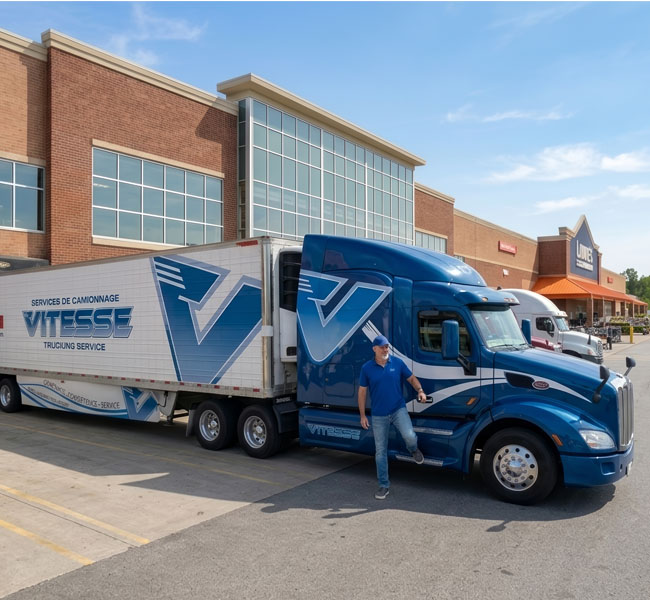
“We’ve watched a lot of freight cycles since 2000, and the ones that catch people off guard aren’t necessarily the expensive ones. They’re the ones where price and capacity move unexpectedly. That’s what we’re expecting this fall on open deck, so asking your carrier more questions than usual is a good idea.” ~ Aldo DeCarolis, Founder & CEO – Vitesse Transport
Questions Worth Raising Before Your Next Open Deck Load
Five things that are reasonable to ask, and that a good carrier won’t mind being asked:
- Whether the quote includes tarping, and how tarp time is billed if the load waits.
- What happens when no flatbed is available on your date. Substitution to rolling tarp at the quoted rate, or a re-quote?
- Who documents securement at pickup, and whether you get load photos as a matter of course rather than on request.
- Whether the fuel surcharge on your quote tracks current diesel or an index that lags it. With rates moving this fast, a stale index is a real number.
- For steel, machinery, or equipment crossing on or after September 8, what entry date your paperwork will actually carry.
Any one of those answers tells you more about how a lane will run than the rate does.
Rolling tarp is the one that gets overlooked, and it’s often the right answer for palletized industrial freight that needs covering and side access both. It’s part of our own fleet, running the same cross-border lanes we’ve worked since 2000. If you’re moving open deck freight this fall and want to talk it through, we’re around.